Recording date:
Duration:
Session:
Speaker:
Co-Authors:
Abstract:
Keywords
Continuous biomanufacturing, integrated processing, microfluidics, microbioreactor, cell lysis, aqueous two-phase extraction.
Abstract
Microfluidic devices have emerged as indispensable tools for advancing the development of novel biomanufacturing methodologies, utilizing their capability to efficiently explore a vast array of variables while minimizing reagent consumption. However, despite their capacity to streamline bioprocess design, the modular potential of these microfluidic devices remains largely untapped, with predominant applications concentrating on individual unit operations. Integrated continuous bioprocessing stands ready to revolutionize bioproduction by simultaneously reducing costs, optimizing yields, and minimizing environmental footprints compared to traditional batch operations.
In this study, we present the development of an integrated microfluidic device tailored for continuous processing, demonstrating its capability to seamlessly connect various unit operations. The system integrates a micro-chemostat module for continuous production of a target protein, a chemical cell lysis module for efficient protein release, and a purification and concentration module utilizing aqueous two-phase systems (ATPS). This setup enables the simultaneous screening of multiple conditions for each operation, elucidating their collective impact on the final product. (Figure 1) (Wahab, Domingues, Azevedo, Chu, Conde and Aires-Barros, 2024).
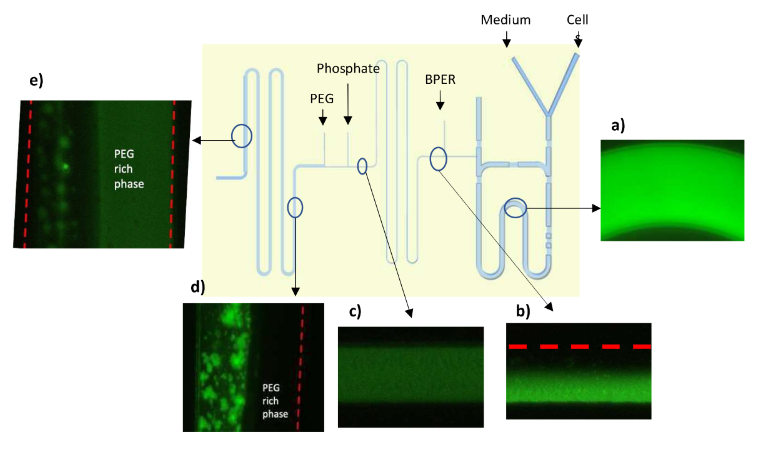
Figure 1: Integrated microfluidic device operation showing: (a) GFP production in a microbioreactor; (b,c) lysis; and (d,e) ATPE
As a model system, we employed a recombinant Escherichia coli (E. coli) strain engineered to produce green fluorescent protein (GFP). This choice facilitated the evaluation of GFP production, lysis efficiency, and partition coefficient via fluorescence microscopy. Over the course of a week- long experiment, continuous medium supply sustained GFP production, while a chemical lysis solution (B-PER®) ensured continuous protein extraction. Subsequently, the extracted GFP was clarified and concentrated in the PEG-rich phase of a PEG/phosphate ATPS system, exhibiting a partition coefficient of 2.
Operating in continuous mode, this integrated device holds the potential for seamless integration of upstream with downstream processing modules, offering a promising pathway for scalable and efficient bioprocessing.
Acknowledgement
The European Union's Horizon 2020 research and innovation program under the Marie Skłodowska-Curie grant agreement No 812909 CODOBIO, within the Marie Skłodowska-Curie European Training Networks framework. IBB Institute for Bioengineering and Biosciences acknowledges funding from FCT-Portuguese Foundation for Science and Technology (UID/05367/2020) and pluriannual BASE and PROGRAMATICO financing (UID/04565/2020).
References
- Wahab M.A., Domingues C., Azevedo A. M., Chu V., Conde J.P. and Aires-Barros M.R.,2024, An integrated microfluidic device for continuous bioprocessing, Separation and Purification Technology, 332, 125702. https://doi.org/10.1016/j.seppur.2023.125702
