Recording date:
Duration:
Session:
Speaker:
Co-Authors:
Abstract:
Keywords
Microalgae, Modelling, Calvin cycle, Photosystem II, Light – Dark cycles
Abstract
In recent times, microalgae technology has been receiving significant attention due to their promising perspectives in several fields. Daneshvar et al. (2022) compared their potential for carbon capture with other conventional methods, highlighting their efficiency and the valorization of the captured carbon into biomolecules, while Patil et al. (2007) compared different species in terms of their fatty acid composition and total output. However, one of the problems facing microalgae technology is the limited availability of light as cultivations increase in cell density, which in turn hinders biomass concentration and productivity. Nevertheless, results from Nedbal et al. (1996), Xue et al. (2011) and Vejrazka et al. (2011) showed that, when high frequency flashes of light (between 10 Hz to 100 Hz) were used instead of the equivalent continuous illumination, the high intensity pulses caused little to no photoinhibition, and growth rate could be maintained at close to the same value. Several qualitative explanations for this phenomenon, known as light integration, have been proposed by Iluz et al. (2012), based on different physiological mechanisms. It is against this background that we aimed to develop, in this study, a mechanistic model which could describe the most significant physiological mechanisms involved, and also explain and reproduce the empirical observations showing more efficient light utilization and increased photoinhibition tolerance.
For that purpose, and based on the descriptions made by Han et al. (2000) and Yoshimoto et al. (2004) of the photon capture units and of the Calvin cycle respectively, we propose here an integrated dynamic model that describes the interaction between both systems (Figure 1). Our model considers the growth rate of the algae to be proportional to the organic carbon output of the Calvin cycle, whose kinetics are described in terms of the fraction of RuBP molecules active in the cycle, and of the available ATP. The production of ATP is proportional to the quantum yield of the photosynthesis, which depends on the turnover rate of the electron transfer chain. The capacity of the photon capture units to initiate the transfer chain is limited by the state of the D1 macromolecule, in the reaction center of the photosystem II complexes. This is here modeled as either functional or inactive, where the transfer between both states is dependent on the restoration and photodamage kinetics.
The model, which can be applied both to cultivations with continuous illuminations and under brief light flashes, has successfully predicted the expected behaviors, such as I) growth rate decline at high light intensities due to photoinhibition, II) more efficient light utilization by the algae under light and dark cycles, and III) growth enhancement as the frequency of the light and dark cycles increases from 0.1 Hz to 10 Hz.
Our model now opens the door to the utilization of CFD-generated cell streamlines to evaluate how the light and dark patterns induced by the flow impact the overall performance of the reactor. As far as known, the integration of this type of data into complex dynamic growth models has not been reported in the literature. However, it is actually in these scenarios (Richmond, 2004) where the main benefits of light integration would be observed. If an efficient circulation of the liquid in the reactor was achieved, so that all cells experience light flashes regularly as they move closer and then away from the light source, the whole volume of the reactor would become productive. This has the potential to greatly improve the throughput of photobioreactors, particularly of those that operate high cell density systems.
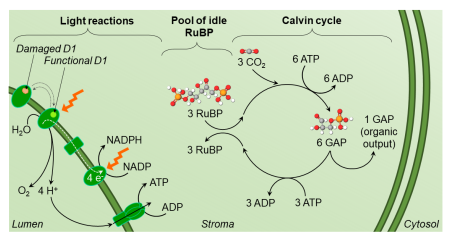
Figure 1: Graphical description of the two systems described by the model, the light reactions and the Calvin cycle
References
- Daneshvar, E.; Wicker, R. J.; Show, P.-L.; Bhatnagar, A. 2022. Biologically-mediated carbon capture and utilization by microalgae towards sustainable CO2 biofixation and biomass valorization – A review. Chem. Eng. J. Vol. 427 (130884).
- Han, B. P.; Virtanen, M.; Koponen, J.; Straskraba, M. 2000. Effect of photoinhibition on algal photosynthesis: a dynamic model. J. Plankton Res. Vol. 22 (5), pp. 865–885.
- Iluz, D.; Alexandrovich, I.; Dubinsky, Z. 2012. The Enhancement of Photosynthesis by Fluctuating Light. Artificial Photosynthesis. Ed. Najafpour, M. Nedbal, L.; Tichý, V.; Xiong, F.; Grobbelaar, J. U. 1996. Microscopic green algae and cyanobacteria in high-frequency intermittent light. J. Appl. Phycol. Vol. 8, pp. 325–333.
- Patil, V.; Källqvist, T.; Olsen, E.; Vogt, G.; Gislerød, H. R. 2007. Fatty acid composition of 12 microalgae for possible use in aquaculture feed. Aquacult. Int. Vol. 15 (1), pp. 1–9.
- Richmond, A. 2004. Principles for attaining maximal microalgal productivity in photobioreactors: an overview. Hydrobiol. Vol. 512, pp. 33–37.
- Vejrazka, C.; Janssen, M.; Streefland, M.; Wijffels, R. H. 2011. Photosynthetic efficiency of Chlamydomonas reinhardtii in flashing light. Biotechnol. Bioeng. Vol. 108 (12), pp. 2905–2913.
- Xue, S.; Su, Z.; Cong, W. 2011. Growth of Spirulina platensis enhanced under intermittent illumination. J. of Biotechnol. Vol. 151 (3), pp. 271–277.
- Yoshimoto, N.; Sato, T.; Kondo, Y. 2005. Dynamic discrete model of flashing light effect in photosynthesis of microalgae. J. Appl. Phycol. Vol. 17 (3), pp. 207–214.
