Recording date:
Duration:
Session:
Speaker:
Co-Authors:
Abstract:
Keywords
Cellulase, enzyme adsorption, biocatalyst consumption.
Abstract
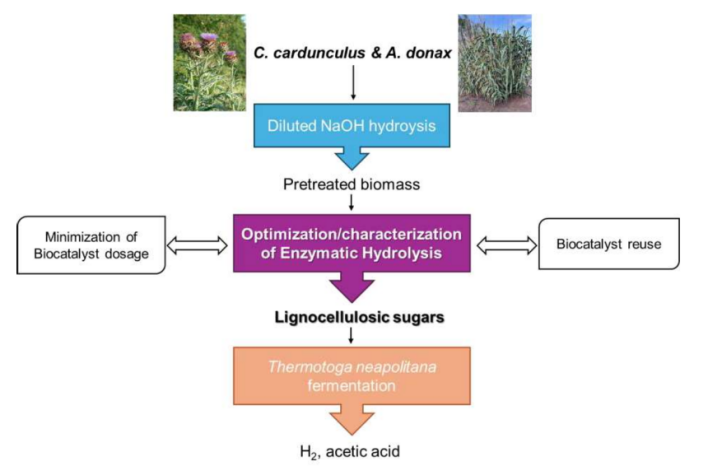
The development of sustainable biorefinery processes goes through the selection of available lignocellulosic feedstock among agro-food wastes and crops fit for the valorization of marginal lands. In addition, efforts are still ecessary to reduce the impact of biocatalyst consumption on the overall costs of the process and thus on the competitiveness of bio-based products on the market as alternatives to fossil counterparts. The present study was conceived to optimize the use of two lignocellulosic biomass largely available in the Mediterranean area and adapted to recent climate changes: Cynara cardunculus (Barracosa et al., 2019), and Arundo donax (Scordia & osentino,2019). These two case studies were addressed in an experimental investigation aimed at the minimization of cellulase cocktail dosage. The rational design of process conditions was based on the assessment of enzyme adsorption on the lignocellulosic biomass particles and the overall rate of production of monomeric sugars (mainly glucose and xylose) as schematically represented in Fig. 1. Diluted alkali hydrolysis was applied as a reliable and
effective reference pretreatment for delignification of the substrate prior to enzymatic hydrolysis (Russo et al., 2022). As a proof of concept, hydrolysates from cardoon and A. donax saccharification were supplemented as carbon sources to Thermotoga neapolitana batch cultures, a thermophilic gram-negative bacterium of primary interest for bio-hydrogen production (Xu & d'Ippolito, 2023).
Results provided information on the adsorption of cellulases from a commercial cocktail on the pretreated biomasses. Maximum adsorption capacities were assessed upon pretreatment and compared with those observed for raw biomasses. The diluted alkali pretreatment made the substrate hydrolysable despite a not extended increase in the enzyme adsorption capacity and a shift from linear to Langmuir-type adsorption equilibrium behaviour. The almost complete irreversibility of the adsorption of cellulases on pretreated biomasses suggested partial recovery and reuse of the unbound biocatalyst fraction. The enzyme dosage for each biomass was minimized to 7-4 mg adsorbed enzymes/g dry biomass to approach glucose yield above 61-90%. Recovered unbound cellulases were tested for enzymatic hydrolysis of cardoon biomass and provided not negligible glucose yield (51.5%) at 2 mg/g adsorbed biocatalyst loading. The cultivation of T. neapolitana was successfully carried out for 200 h at 75°C. Hydrolysate were diluted to 6.0 g/L glucose and 2.0 g/L xylose, a synthetic medium with equal sugar content was used as a control. Upon a 60 h lag phase, the cultivation reached 1.17 OD600nm, 1.2 g/L acetic acid and 30% H2 production in the gas outlet (1.4 atm) at 140 h. The next steps will include the test of cardoon hydrolysate as a carbon source for T. neapolitana cultivation and the dosage/composition adjustment of recovered unbound cellulases.
Acknowledgement
The study has been partially funded by the Ministero dell'Università e della Ricerca within the project CN00000022 (decreto di concessione del finanziamento n. 1033 del 17/06/22 CUP - E63C22000920005) - "Centro Nazionale per Tecnologie dell'Agricoltura" - Agritech - "Tecnologie dell'Agricoltura".
References
- Barracosa P., Barracosa M., & Pires E. 2019. Cardoon as a Sustainable Crop for Biomass and Bioactive Compounds Production. Chemistry and Biodiversity 16(12). https://doi.org/10.1002/cbdv.201900498
- Russo M. E., Procentese A., Montagnaro F., & Marzocchella A. 2022. Effect of enzymes adsorption on enzymatic hydrolysis of coffee silverskin: Kinetic characterization and validation. Biochemical Engineering Journal, 180, 108364. https://doi.org/10.1016/j.bej.2022.108364
- Scordia D., & Cosentino S. L. 2019. Perennial Energy Grasses: Resilient Crops in a Changing European Agriculture. Agriculture 2019, 9, 169. https://doi.org/10.3390/agriculture9080169
- Xu Z., & d'Ippolito G. 2023 Thermotoga neapolitana. Trends in Microbiology 31(1). https://doi.org/10.1016/j.tim.2022.09.009
