Recording date:
Duration:
Session:
Speaker:
Co-Authors:
Abstract:
Keywords
Biofilm, continuum model, particulate matter, residence time.
Abstract
The design, scale-up and optimisation of biofilm-based processes, particularly for wastewater treatment operations, is a mature field (Wanner et al., 2006; Wei and Yang, 2023). However a neglected area is the interaction between particulate organic matter (in the bulk phase) and the attached phase (biofilm). Mathematical models are useful for the analysis of the complex processes inherent in such systems (Wanner and Gujer, 1986; Duddu et al., 2009). Time scales for substrate diffusion and rate of growth and decay of biomass during development of monospecies biofilm are estimated to differ by around two orders of magnitude (Wanner et al., 2006).
Microfluidic systems are increasingly used to investigate mass transfer characteristics in the biofilm development (Ford and Chopp, 2020; Wei and Yang, 2023). A high surface-to-volume ratio in these systems provided an increase in rate of mass transfer (Ford and Chopp, 2020). It potentially leads to longer residence time for substrate uptake in the attached phase. On introduction of dominant convective forces, fast substrate diffusion from bulk phase into biofilm may occur due to the reduced diffusion distance. It is hypothesized that the increase in residence time at different flow rates and short diffusion time actively promote the interaction between particulate organic matter and biofilm. The goal of the present study is to develop a fully continuum model to explain the trends of kinetics of particulate organic matter and its interactions with the biofilm, when coupled to these hydrodynamic flows.
A simple set of one-dimensional transport equations that constitutes a two-compartment model for different biomass rate expressions is formulated. The fully continuum model represented the mass and momentum balance for substrate and particulate transport within a microfluidic domain. The residence time distribution at different flow rates are coupled with these expressions, to describe the particulate interactions at the biofilm interface. Substrate flux from bulk flow to the biofilm is predicted to explain the effect of flow regime on the biofilm thickness. Case studies with laminar flow (Reynolds number between 0.01 to 10) are considered to simulate static or dynamic biofilm development at different residence times and theoretical rate expressions, and are implemented using MATLAB®.
From preliminary numerical solutions for assumed Monod kinetics, substrate flux is found to increase with an increase in inlet flow rate. The above mathematical model is compared to the existing, monospecies biofilm models based on the fully continuum description and to be validated numerically within acceptable error limits (root mean square error less than 20%). The results indicate the potential of a continuum description to unfold the mechanisms that govern the particulate matter during biofilm formation in confined environments.
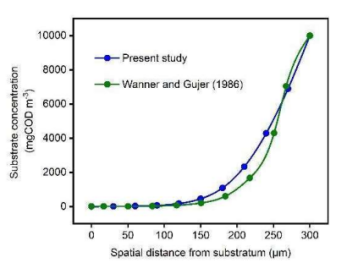
Figure 1: Simple 1D fully continuum model for biofilm growth (present study) in comparison to the existing model in literature
Acknowledgement
The authors (RKM and EC) would like to acknowledge generous funding received through ERC Advanced Grant for ABSOLUTE project, funded by European Research Council (ERC)), to support the present work at University College Dublin (UCD project code: R23637).
References
- Duddu R., Chopp D. L. and Moran B., 2009. A two-dimensional continuum model of biofilm growth incorporating fluid flow and shear stress based attachment, Biotechnol. Bioeng., 103, 1, 92-104
- Ford N., and Chopp D., 2020. A dimensionally reduced model of biofilm growth within a flow cell, B. Math. Biol., 82, 40
- Wanner O., Eberl H., Mogenroth E., Noguera D., Picioreanu C., Rittmann B., and Loosdrecht M. V., 2006. Mathematical Modeling of Biofilms, IWA Publishing, UK
- Wanner O., and Gujer W., 1986. A multispecies biofilm model, Biotechnol. Bioeng., 28, 314-328
- Wei Y., and Yang J. Q., 2023. Microfluidic investigation of the impacts of flow fluctuations on the development of Pseudomonas putida biofilms, npj Biofilms Microbiomes, 9, 73
